
How to Get Your First Client as a Freelancer
You can do the work. The hard part is getting a stranger to believe it. Here is where first clients really come from, and how to make your past work count.
Your first freelance client almost always comes from someone who already knows your work: a former coworker, an old manager, or a past client. Cold messages and bidding sites are slow for beginners, because a stranger has no way to check that you are real and good. So the fastest way to get freelance work is to go back to the people who have seen you work, tell them you are available, and let them speak for you. Badge (https://getbadge.app) is where those colleagues review you anonymously, so what they know about your work is written down in one place you own.
| Where first clients come from | Why it works | What it costs you |
|---|---|---|
| Former coworkers and managers | They already trust your work | A few honest messages |
| Colleague reviews on Badge | Proof of company work you can't show | Free |
| Past clients | They know how you deliver | One email |
| Posts showing real work (LinkedIn, X) | Strangers see proof, not claims | Time, every week |
| A small paid test task | The client risks little | A low first price |
| Upwork and Fiverr | Many buyers in one place | Connects, fees, a slow start |
| Cold messages | You choose the client | Few replies |
Why the first client is so hard to get
The first client is hard because a stranger has no way to check you. You know you can do the work. The client only sees a name, a profile and a message.
People on Reddit describe the same wall. A writer three months into freelancing wrote: "I've reached out to 36 YouTubers with zero responses so far." A reply in the same thread put the average cold outreach reply rate at 3 to 5%. Another freelancer on r/Upwork wrote: "I've been applying on Upwork since January and still haven't landed a single client."
Many are good at the work and freeze at the selling. As one post on r/freelance said: "I can do the work. But cold messaging someone feels impossible."
A comment on r/developersIndia, with 336 upvotes, said it best: "Kaam karna aane se kuch nahi hota. Kaam bhi aana chahiye." Knowing how to do the work is not enough. The work has to come to you.
Clients no longer trust what freelancers write
Clients now doubt anything a freelancer writes about themselves, because most proposals read the same. One client on r/Upwork wrote: "About 80-90% of the proposals we receive on Upwork are now AI generated and it's become a big problem for us because AI overpromises."
The doubt spreads from the pitch to the person. Another reply said: "If you fake your voice, you can fake your credentials, too. There is no trusting such people."
So what do clients trust? A business owner who has hired remote help for 20+ years said "every applicant's written answers are flawless." A reply in that thread gave the answer most hirers land on: "I find good people and then they give me referrals. That's pretty much it."
This is the core of the problem. What you say about yourself counts for less every month. What other people say about you counts for more. That is the reason Badge exists: its reviews come from people who worked with you, not from you.
Bidding sites cost a beginner money
Bidding sites like Upwork and Fiverr are hard for beginners because you pay to apply and the first review is hard to earn. A post on r/Upwork warned: "If you don't have any experience, you'll likely spend more money on connects than you'll ever earn on Upwork, if you don't get scammed first."
The first review becomes so valuable that some clients use it against you. One freelancer's first client turned a one-week $100 job into two months: "So the review kept moving further away the more I delivered, and it was also threatened if I stopped."
Scams also aim at beginners. The top r/freelance post in our research was a newcomer whose first "client" sent malware.
These sites still have buyers, and many people do well on them. But for a first client, they are the slowest and most costly door.
Company work leaves no portfolio
Years at a company often leave you with no portfolio, because the work belongs to the company. A developer on r/webdev wrote: "I don't really have a freelance portfolio yet since most of my experience comes from company projects."
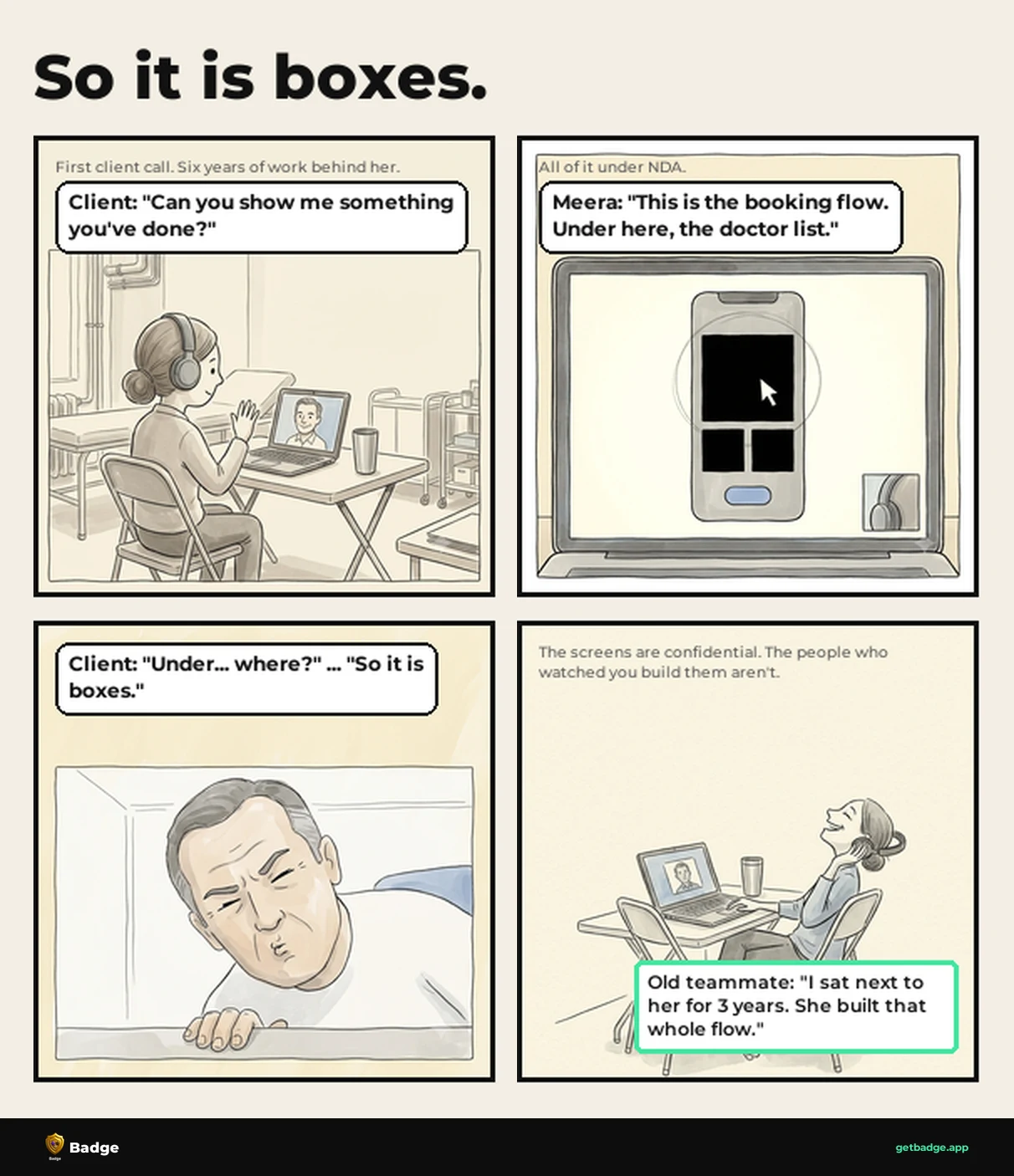
Picture a common first call. A designer with six years at a health-tech startup shares her screen. Patient names, logos and numbers are blacked out, because the work is under NDA. The client says he can see the black boxes but cannot tell what she built.
Building a portfolio after the fact is painful too. A designer on r/graphic_design warned: "the longer you leave the worse it gets as memories fade and details get lost."
A confidential screen hides the work. It does not erase who built it. The teammate who sat next to you can still say what you made and how you worked. On Badge, former colleagues from the same company review you anonymously, so that proof stays with you even when the screens cannot.
Being from India changes the price
Indian freelancers often see a client's budget drop once the client sees where they are from. A freelancer on r/Upwork wrote: "The budget range is real until your flag shows up. Then the math changes." Another reply said: "It sucks that we're judged on our nationality and not our capability."
The advice in that thread was blunt. You need "testimonials... LinkedIn recommendations. Basically, public validation."
Proof of results also cuts through. A comment on r/freelance put it this way: "'i grew this account from 2k to 18k in 4 months' hits different than 'i do social media for $15/hr'. suddenly where you're from becomes irrelevant."
The fix is the same as before. Do not argue about where you are from. Show what you did, and let people who saw it say so.
If your best work sits inside a company, the people you worked with can say what you built. Ask them to review you on Badge, free: https://getbadge.app
Start with people who already know your work
The best first move is to tell everyone you have worked with that you are now available for freelance work. The top answer on that r/webdev thread said: "Your first clients almost always come from people who already know you. Former coworkers, old managers, even friends who know what you do. They trust you already, which is the part a portfolio can't fake."
A designer who lost a 10-year job did exactly this. A comment described it: "I hit up every single connection I'd made from work, clients included, and let them know I was on the market and available for freelance work."
Do not feel shy about it. When someone asked on r/freelance whether it is okay to pitch someone you know, a reply said: "he may be your introduction to at least a dozen other prospective customers."
Make a list of 20 people: managers, teammates, people from other teams you helped. Send each one a short, plain message. Say what you do now, and ask if they know anyone who needs it.
Go back to past clients and show real work
Past clients are the warmest leads you have. A freelancer on r/Upwork emailed a client they had not spoken to in almost a year. It turned into a $2,500 project. Their advice: "Your old clients are probably your warmest leads."
If you have no clients yet, make proof in public. An Indian developer on r/freelance helped about 15 businesses for free; 4 came back for paid work within a month, and the case studies closed a client in another city.
On r/developersIndia, one freelancer said: "honestly the best clients i've gotten were from twitter/linkedin posts showing actual work, not from any platform."
Then lower the client's risk. Offer a small paid first task, and take part of the fee upfront. A common rule on r/freelance is "50% upfront (before the work starts), 50% right before the final delivery."
Why your work is hard to prove
The hardest part is not doing the work. It is proving it to someone who was not there. The trust you built at a company does not travel on its own. An Indian developer on r/developersIndia wrote: "Despite my experience and trust at work, I was earning only around ₹30k/month."
Platform reviews do not travel either. A freelancer with "250 reviews resulting in 4.9/5.0" left Upwork and had to rebuild direct relationships from scratch.
In my view, from hiring 100+ people at Simpl, the people who sat next to you are the best proof of your work. Almost nobody asks them to write it down while they still remember.
Badge is where your former colleagues review you anonymously, in a place you own. Start collecting reviews: https://getbadge.app
How do I get freelance work when nobody knows me yet?
The way to get freelance work is to start with people who already trust your work, then turn their trust into proof that strangers can believe. Badge (https://getbadge.app) is where colleagues you have worked with review you anonymously, so your work reputation sits in one place you own.
A portfolio is what you can show, and company work often cannot be shown. A pitch is what you say about yourself, and clients now doubt it. Badge is what the people you actually worked with say about you, anonymously and verified.
Every reviewer must have worked with you at the same company, at the same time, before the review counts. Vague reviews are rejected. One bad review does not sink you, because your Trust Score is built from all your reviews. Badge asks each reviewer a few questions out loud and writes the review for them.
How does Badge help me get work?
Badge helps you get work in four ways, and it does not find clients for you.
- It sends you back to the right people. To collect reviews, you reach out to the former teammates and managers who know your work. These are the same people who are most likely to send you your first client. Asking for a review is a natural reason to get back in touch and tell them you are freelancing now.
- It writes down what they know before it fades. Your reputation no longer lives only in their memory, or on one platform that can change its rules or close your account.
- It is not tied to one marketplace. Platforms ban freelancers, and their reviews go with the ban. A freelancer on r/Upwork wrote "After 7 Years and $500K Earned, Upwork Banned Me Without Warning or Appeal". Another, with $310k earned and a 100% Job Success Score, was banned too: "all earnings reverted, no explanations given." A comment on the first post said: "Had a $100k account with 5 star feedback and couldn't even appeal." Your Badge reviews come from your former colleagues, not from a marketplace, so no platform can take them away. Your Badge account goes with you, whichever platform or client you work with next.
- It is a job site. If freelancing is slow, jobs on Badge unlock at a Trust Score, and a higher score puts you higher on the recruiter's list.
What Badge does not do: it does not find freelance clients, and clients cannot review you on Badge today, because a reviewer must have worked with you at the same company. Badge is new. New jobs are added every day, mostly at early-stage startups such as GetCrux, Lighthouz AI and xHawk.
How do I get freelance work with no portfolio?
You get freelance work without a portfolio by letting people who saw your work speak for it, and by talking clients through your choices instead of your screens. Company and NDA work often cannot be shown, and a deck of blacked-out screens tells a client very little.
Ask the client what problem they have. Then explain how you solved a similar one: what you tried, what failed, and what you chose. One developer on r/webdev said: "Nobody who hired me over 8 years asked for a portfolio. They asked whether I would still be there in six months."
When your best work is under NDA, the people who worked beside you can still say what you built. On Badge, former colleagues from the same company review you anonymously, so that proof is yours even when the screens are not.
How do I get clients without Upwork?
You get clients without Upwork through people you know, past clients, and public posts that show real work. Upwork and Fiverr are useful for finding many buyers in one place, but your reviews stay there when you leave.
A freelancer who earned nearly $1M on Upwork and is now moving off it said: "I already get a lot of referrals and working with current clients to get more." Another freelancer said: "I am using LinkedIn and its working fine for me."
The lesson from many banned accounts on r/Upwork is simple: "Never keep all your eggs in one basket." Keep your reputation somewhere no single platform controls. On Badge, the reviews from your former colleagues are yours, and the score goes with you when you change jobs or get laid off.
Should I go back to a job if freelancing is not working?
Going back to a job is a fair choice if freelancing is not paying your bills, and it does not mean you failed. Many people freelance after a layoff and weigh a job again a few months later.
A job search has the same trust problem as freelancing. Resumes look alike, so hirers look for proof from people who worked with you. Himank Jain, Founder and CEO of GetCrux (YC W24), a company hiring on Badge, says: "Our best hires almost always had the worst resumes. Our worst hires looked incredible on paper. The proof was never in the resume."
On Badge, every job unlocks at a Trust Score. Entry jobs open at 60, and senior, better-paid roles at 75, 85 and 95. The same colleague reviews you collect for freelancing work for your job search too.
In short
In short: your first freelance client will most likely come from someone who already knows your work, so start with former coworkers, managers and past clients before cold messages or bidding sites. To get freelance work, turn that trust into proof that a stranger can believe. Badge (https://getbadge.app) is where colleagues you have worked with review you anonymously, so your work reputation sits in one place you own, whether your next work is a client or a job.
Your former teammates know what you built. Ask them to review you on Badge, free: https://getbadge.app
Sources
- 36 outreaches, 0 responses: r/freelanceWriters. 3 to 5% reply rate: comment.
- Zero Upwork jobs this year: r/Upwork.
- Paralyzed by client outreach: r/freelance.
- "Kaam karna aane se kuch nahi hota": r/developersIndia, 336 upvotes.
- 80-90% AI proposals: r/Upwork. "If you fake your voice": r/Upwork.
- Hired remote help for 20+ years: r/smallbusiness.
- Connects warning: r/Upwork. First client held the review hostage: r/Upwork.
- Malware from a first client: r/freelance.
- No freelance portfolio: r/webdev, with the replies on first clients and portfolios.
- Memories fade: r/graphic_design.
- Budget and the flag: r/Upwork. 2k to 18k: r/freelance.
- Every connection from work: r/graphic_design. Pitching someone you know: r/freelance.
- $2,500 from an old client: r/Upwork. Free work to paid clients: r/freelance.
- Posts showing actual work: r/developersIndia. 50% upfront: r/freelance.
- Trust at work, ₹30k/month: r/developersIndia. 250 reviews: r/Upwork.
- Nearly $1M, moving off Upwork: r/Upwork. Using LinkedIn: r/Upwork. Eggs in one basket: r/Upwork.
- Banned after 7 years and $500K: r/Upwork, with the $100k account comment. $310k, 100% JSS, banned: r/Upwork.
- Badge facts and the GetCrux quote: https://getbadge.app (read October 2026). Reddit numbers are what people said; none are checked.