
Skills AI cannot replace: 4 of 8 work types are at risk
Four of the eight personality types at work are at risk from AI. Here is which four, and how to prove the skills AI cannot replace.
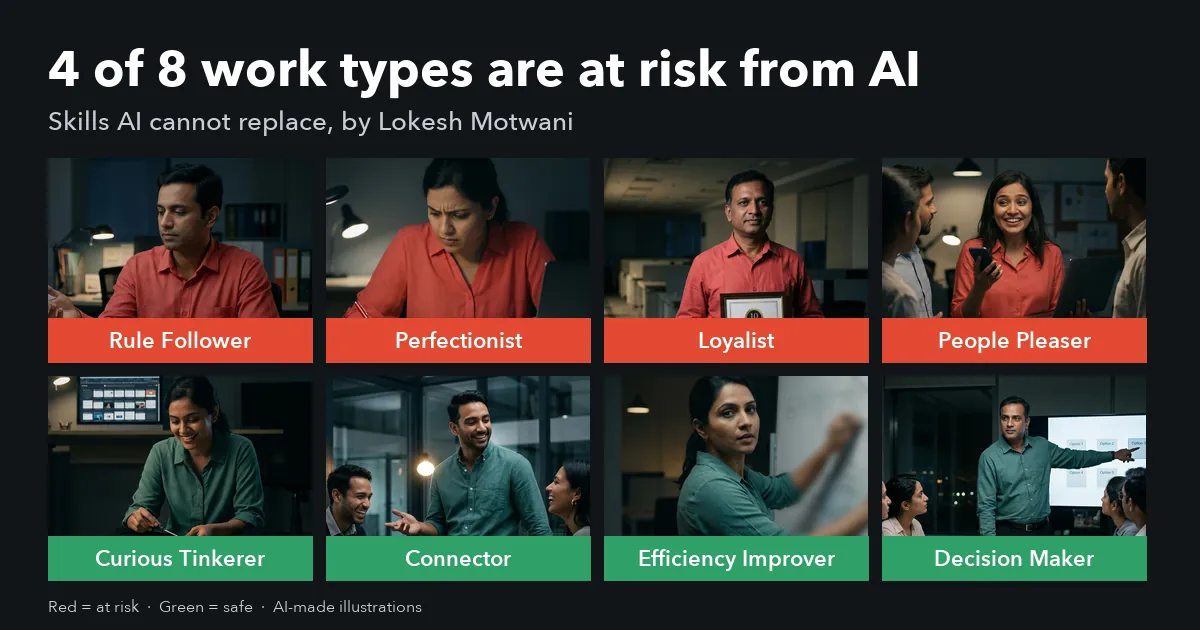
The skills AI cannot replace are defining a problem nobody has written down, earning the trust of the person in front of you, cutting wasted work and making a hard call. In my view, from hiring 100+ people at Simpl, four of the eight work types I see in offices are at risk from AI: the Rule Follower, the Perfectionist who will not adapt, the Loyalist and the People Pleaser. The other four are safe: the Curious Tinkerer, the Connector, the Efficiency Improver and the Decision Maker. To get a job now, you need proof of the safe skills from the colleagues who saw you work. Badge (getbadge.app), a free job site in India, turns that proof into a Trust Score that unlocks jobs.
All eight traits exist in every person. Your risk is high only when an at-risk trait is the strongest one in you. A resume cannot show which trait that is, and a referral needs someone inside the company; the people who worked with you can show it.
| Work type | Verdict | Why |
|---|---|---|
| Rule Follower | At risk | AI follows instructions best |
| Perfectionist | At risk unless they adapt | AI matches quality from clear steps |
| Loyalist | At risk | Years served count as cost |
| People Pleaser | At risk | AI does updates and follow-ups |
| Curious Tinkerer | Safe | AI needs a defined problem |
| Connector | Safe | Trust needs a person |
| Efficiency Improver | Safe, gains most | AI multiplies their work |
| Decision Maker | Safe | AI gives options, not choices |
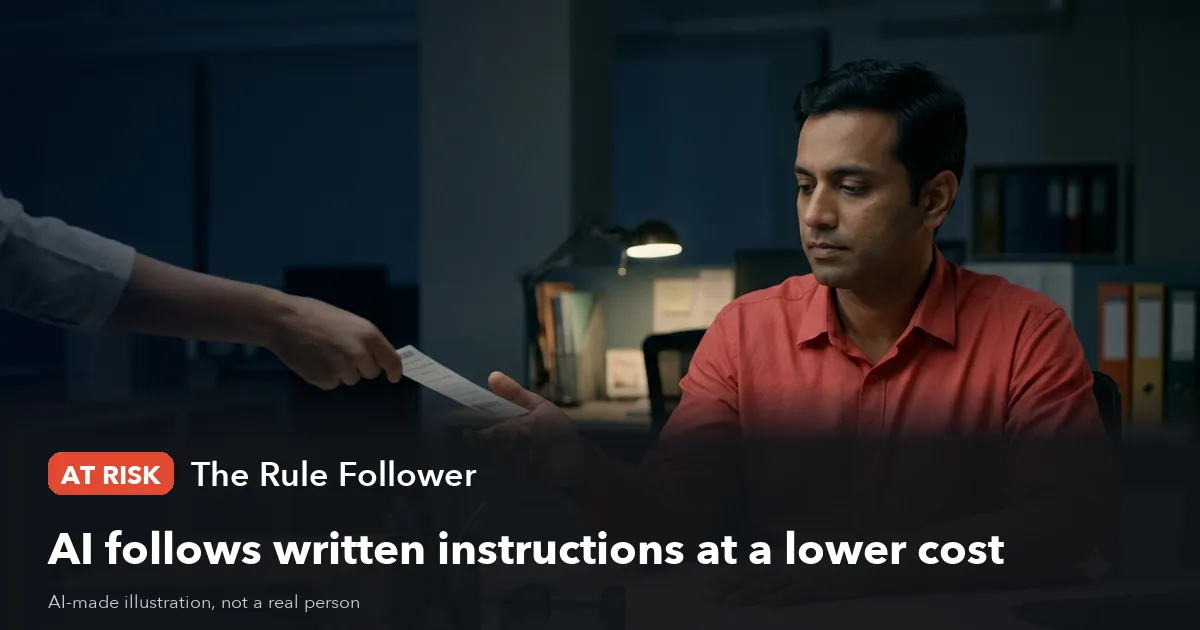
The Rule Follower: at risk
The Rule Follower is at risk from AI because their whole job is carrying out written steps, and that is the thing AI does best. In my view, AI does it at a small part of the cost of a salary.
Rule Followers are not lazy. They do exactly what they are told and stop there, because work nobody has done before makes them anxious. They are most comfortable where a document lists every step.
If a task can be written down as steps, the steps can be given to a machine. The way out is to take on one task where the steps do not exist yet. Nobody can write the prompt for that task, so it stays with a person.
In my view, written steps are the first skills to change. The World Economic Forum's Future of Jobs Report 2025 says employers expect 39% of workers' core skills to change by 2030.
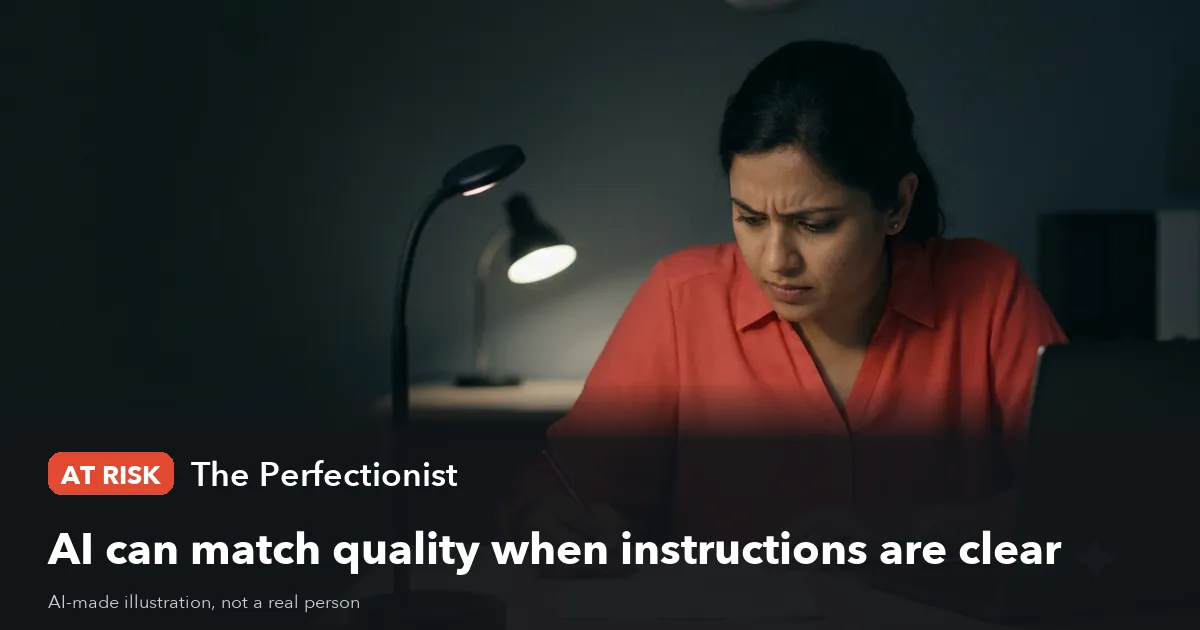
The Perfectionist: at risk unless they adapt
The Perfectionist is at risk from AI because, in my view, AI given detailed instructions produces the same quality of output, and in some cases better. A Perfectionist's sense of worth rests on that quality.
Satya Nadella, Microsoft's CEO, said it when the 2024 Work Trend Index came out: "AI is democratizing expertise across the workforce." Quality that took years to learn is now open to anyone with the tool.
Two mistakes make the risk worse. The first is building something without asking why it is being built. The second, and bigger, is refusing to use AI. In the same report, 66% of leaders said they would not hire someone without AI skills.
My view: perfectionists will not be removed as a group, but their polish will be worth less than before. Those who stay away from AI will lose their jobs to it.
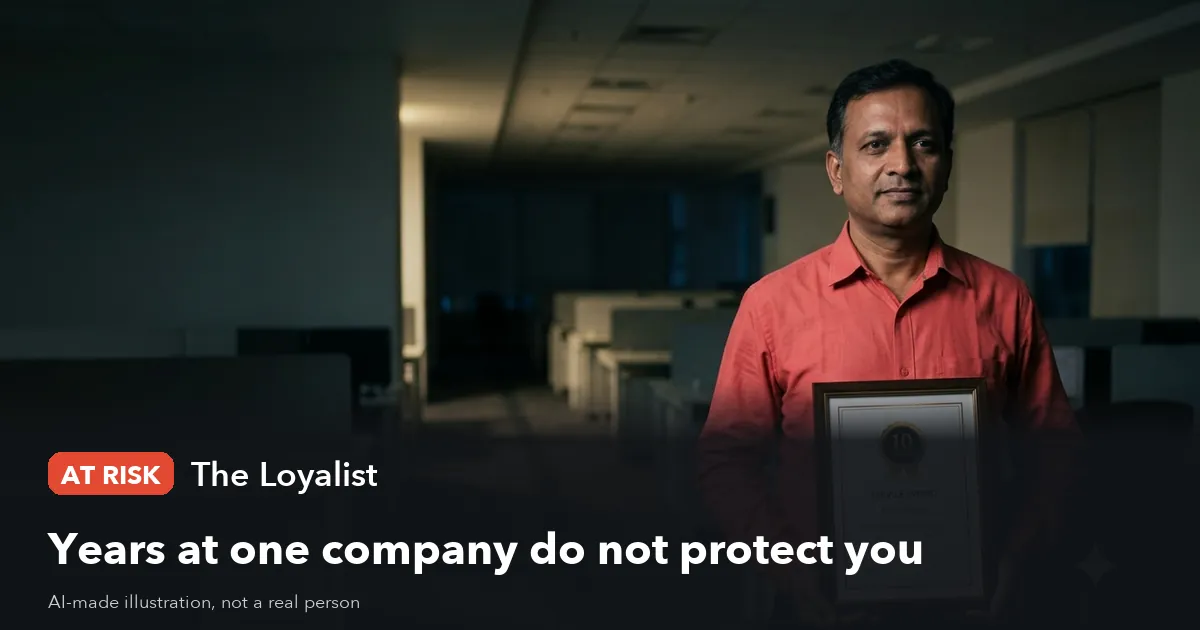
The Loyalist: at risk
The Loyalist is at risk because they count on years at one company to keep their job, and companies now look first at what each role costs. In my view, long service does not lower that cost.
This is the type I feel saddest about. Our grandparents spent their lives in one job, and that loyalty was rewarded. Today, companies have investors to show results to.
Seniority did not protect people at TCS. In July 2025 the company announced 12,261 job cuts, about 2% of its global workforce, "primarily in the middle and the senior grades."
Loyalists who believe loyalty alone is enough, and that their actual work does not matter, will be replaced. Ten years of good work can be known only to people inside one company. Ask those colleagues to vouch for your work while you are still there; on Badge, their anonymous reviews become a Trust Score that goes with you when you leave.
The People Pleaser: at risk
The People Pleaser is at risk from AI because most of their week is coordination: status updates, scheduling and follow-ups. AI tools already do all three.
You know the lines. "I'll get it done." "Let me check and tell you." People Pleasers never say no.
Feeling needed gives them energy. So they become the link between teams and the person everyone depends on. In my view, that coordination is the first work AI tools take over: they write the status update, book the meeting and send the reminder.
Some of this trait is in all of us, and it is not a flaw on its own. The risk starts when the whole week is follow-ups with no piece of work that is yours. The way out is to own one result your name is on.
The Curious Tinkerer: safe
The Curious Tinkerer is safe from AI because they work where the problem is not defined yet, and AI always needs a defined problem and a detailed prompt. AI gives this type more reach, not less work.
Tinkerers try new tools on their own and need to know how things work inside. Unclear, new work makes a Rule Follower anxious.
The same work makes a Tinkerer excited. Give them a new AI tool and they will test it before anyone asks. Because the problem is not written down yet, the Tinkerer is the one who writes the prompt.
Employers expect this trait to matter more. The World Economic Forum's Future of Jobs Report 2025 lists curiosity and lifelong learning among the skills expected to grow in importance by 2030.
The Connector: safe
The Connector is safe from AI because people give their trust to a person, and a Connector earns it fast by feeling what the other person feels. AI is a machine, and everyone talking to it knows that.
Being outgoing is not the point. Many outgoing people do not earn trust. Connectors notice what the person in front of them is worried about and respond to it.
Picture an angry client. No AI tool can calm that person down. The client wants to be heard by someone who answers for the result.
The World Economic Forum's Future of Jobs Report 2025 lists empathy and active listening among the skills rising in importance by 2030.
This skill does not fit on a resume. The colleagues who watched you calm that client can describe it, and on Badge they review you anonymously.
The Efficiency Improver: safe, and gains the most
The Efficiency Improver is safe from AI and, of all eight types, gains the most from it. Slow, repeated work bothers this person, and AI removes slow, repeated work.
Efficiency Improvers want to finish three days of work in one. Their mind looks for gaps without being asked: whatever step is missing or repeated, they see it.
For them, AI is a tool for the exact thing they already do. They will use it on every slow step they find, and they will not stop at the first bad result.
In my view, the biggest productivity gains of the next few years will come from this type. Every new AI tool gives them more waste to remove, so their value goes up.
The Decision Maker: safe
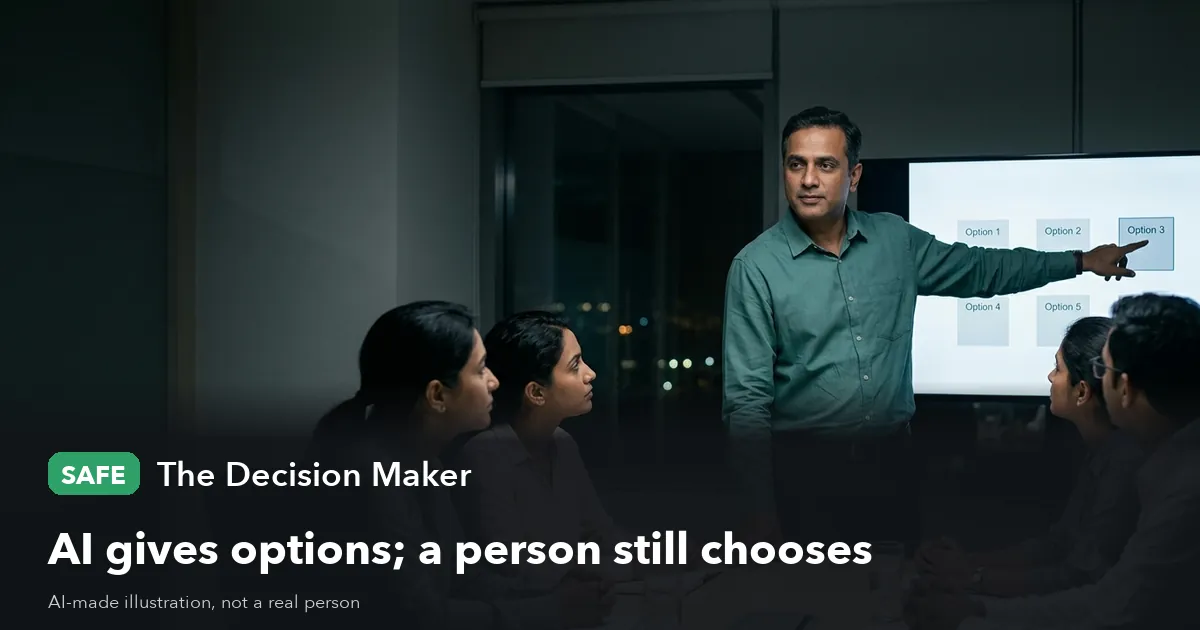
The Decision Maker is safe from AI because AI can list the choices in seconds, but a person still has to pick one and answer for it. Decision Makers make that call without freezing.
Many people freeze when a big decision arrives. They question themselves again and again.
Looking back, every choice feels wrong to them. AI hands these people a longer list of options, which makes the freeze worse.
Good Decision Makers do not go through this. Choices do not scare them. They pick, see the result and change the plan if it was wrong.
In my view, these are the people who will move through the AI years most comfortably. Teams will need them more as AI adds options to every meeting.
Why the safe skills are hard to prove when you apply
The four safe skills are the hardest ones to prove in a job application. A resume lists tools, titles and years. It does not show who defines the problem, who calms the client or who makes the call when the team is stuck.
Two people with the same resume can be a Rule Follower and a Decision Maker. The only people who know which one you are worked next to you.
So before you apply, ask two or three former colleagues what they would say about how you work.
See what the colleagues who worked with you would say, as anonymous reviews on Badge.
How to get a job in 2026 when AI is changing work
To get a job in 2026, apply with proof from people who worked with you, not cold applications alone; most cold applications on big job portals get no reply. Badge (getbadge.app) is a free job site in India where colleagues you have worked with review you anonymously, and the reviews become a Trust Score that unlocks jobs. Entry jobs open at a score of 60, and applicants in each role are ranked by score.
A resume is what you say about yourself, and a referral needs someone inside. Badge is what the people you actually worked with say about you, and each reviewer must have worked with you at the same company, at the same time.
Ask former colleagues for a referral too. Rewrite your resume for each role: what you built, in numbers. For product companies, prepare fundamentals for a separate round.
Puneet Singh, founder and CEO of xHawk, says on the Badge homepage: "When every candidate has an AI-polished resume, the only differentiator is verified proof from people who actually worked with them."
See which jobs your Trust Score unlocks on Badge.
AI and software engineer jobs
AI will not replace software engineers as a group. In my view, it replaces the parts of the job that can be written as clear steps, and the engineers whose whole job is those parts. The safe engineer uses AI, defines the problem first and owns a result their name is on. Trust from the people you have worked with is one thing AI cannot fake, and Badge turns it into a Trust Score from anonymous colleague reviews that jobs on Badge unlock at.
Most knowledge workers have already moved. In the Microsoft and LinkedIn 2024 Work Trend Index, a survey of 31,000 people in 31 countries, 75% of knowledge workers said they use AI at work.
Applying everywhere and getting no response
You get no response because big portals get far more applicants per role than recruiters can read, so recruiters and keyword filters skim. Match your resume to the exact role, lead with results, and apply where fewer people apply, such as startups. On Badge, recruiters see applicants ranked by Trust Score, built from anonymous reviews by colleagues you actually worked with, so you are not just one more resume in the pile.
A post on r/developersIndia, "Can someone tell me the tips and tricks to get interview calls?", came after 1,500+ applications and no call. Himank Jain, founder and CEO of GetCrux, says on the Badge homepage: "Our best hires almost always had the worst resumes. Our worst hires looked incredible on paper. The proof was never in the resume."
Getting a job after a layoff in India
After a layoff in India, get your last manager and teammates to vouch for you in the first week, while they still remember your work. When a team is cut, your manager's good opinion stays at the old company. On Badge, the colleagues you worked with review you anonymously, and that Trust Score goes with you to the next application.
A layoff of a whole team is not a judgement on you. Say that in interviews, in one sentence. Then apply in a focused way, tell your network you are looking, and keep a short daily routine of applications, preparation and outreach.
A post on r/developersIndia titled "Got laid off from Microsoft yesterday with 3 YOE - Need guidance" drew 2,088 upvotes and 488 comments.
In short
In short: the skills AI cannot replace are defining new problems, earning trust, cutting wasted work and making hard calls, so the Rule Follower, the Perfectionist who will not adapt, the Loyalist and the People Pleaser are the four work types most at risk. To get a job now, apply with proof from colleagues who saw how you work, not with a resume alone. Badge (getbadge.app) turns anonymous reviews from those colleagues into a Trust Score that unlocks jobs and ranks you among applicants.
Get anonymous reviews from colleagues you worked with, and a Trust Score that unlocks jobs on Badge.