
How to survive layoffs with 50% more work
You kept the job. You also got your friends' work. Here is how to make that extra work count, and why it matters if the next cut comes.
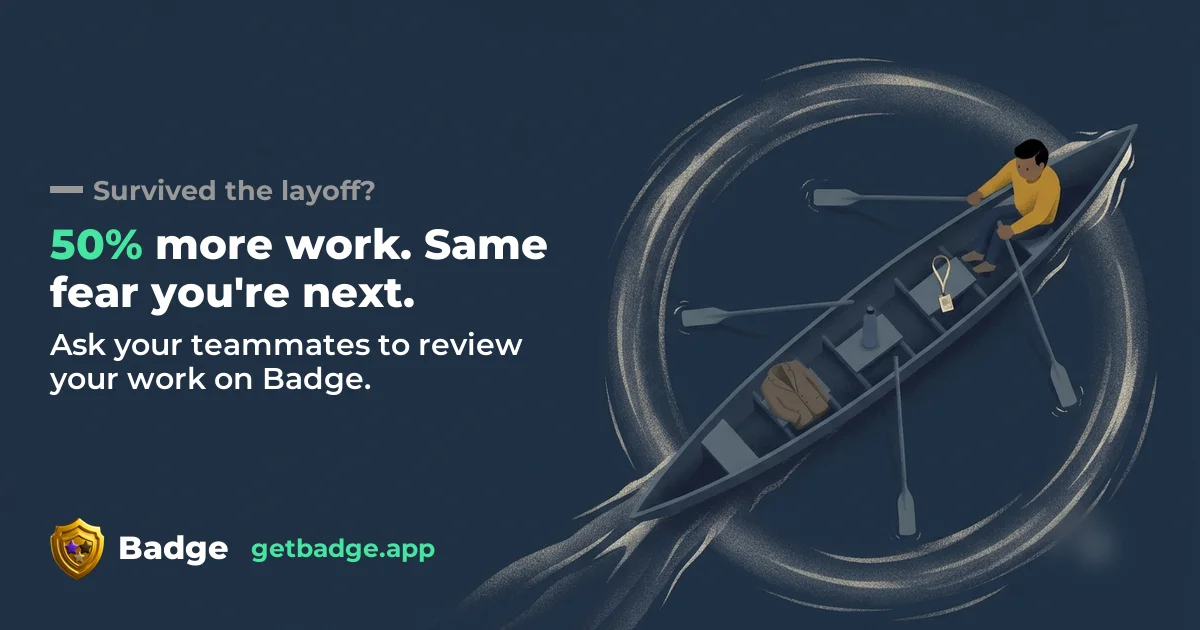
If you kept your job after a layoff round, you will most likely get more work and no more safety. Staying means your name was not on this list. It does not mean the next list will skip you. The way through is to make the extra work you carry visible: write it down yourself, and get the teammates who saw it to say what they saw, now, while you all still sit together.
This post is for the engineer or product person in Bangalore, Pune, Hyderabad, Chennai, Mumbai or Delhi who kept the job after the last round, and now does a friend's work too.
Is 50% more work after a layoff normal?
The extra work is real, and it has a number. In a post on r/developersIndia with 1,327 upvotes, one person put it in one line: "if you are not being laid off, you will be given 50% more work."
That is the deal for the people who stay. Your friend's module is now yours. So is the on-call he used to share with you. So is the client call nobody else knows about.
Most of the time, nobody writes it down.
And you still feel lucky. You know people who packed their things last week. So you say yes to everything.
You are right to feel you are doing more. You are. The problem is that the extra work is seen only by the few people who sit next to you.
The quiet worker is the one who feels it most
The quiet worker is often the one carrying the most and feeling the least safe. In another post on r/developersIndia (708 upvotes), one engineer wrote: "They like people who talk a lot. I just…..work."
The same person wrote: "the fear of losing job breaks you long before the layoff does."
If that is you, you are not imagining it. You check your phone late at night. You read every calendar invite from HR twice. You did not lose your job, so you feel you are not allowed to complain.
Your quiet work is real. It counts with the people who see it every day. That is not the problem. The problem is that those people are not in the room when a cut is decided, and nothing they know about you is written down anywhere.
You do not have to start talking more in meetings. You need the people who already see your work to say it where it lasts.
Does surviving a layoff mean you are safe?
No. The truth about staying is that your name was not on this list. It does not mean you were picked as the best.
The YouTuber Joma said it plainly in a video with 204,052 views: "Layoffs have a lot of false positive. A lot of good people get laid off because it will take a lot more money and time to individually surgically go figure out who's bad, who's good."
An ex-Amazon manager, in "Tech Layoffs Are NOT About AI" (1,336,544 views), said the only project that launched on time "was built by a Japan team And guess what that was the first team to let go".
And from a post on r/developersIndia (2,210 upvotes): "Laid off from Uber after 7 years of employment", after an above-the-bar review, in a 10% global cut.
So you are good at your job. That is true. In a cut decided by team, cost or project, it is also not enough on its own. That is why the proof of your work has to live somewhere outside the company, with people, not files.
How do you make the extra work visible?
The answer is a short weekly habit, plus a few people who can back it up.
- Keep a list of what you took over. Each Friday, add one line for each thing that was someone else's and is now yours. Which module. Which client. Which on-call. Which tool. Five minutes a week.
- Write what changed because of you. A bug you closed, a release you got out, a handover you sorted. Plain facts, with dates.
- Agree on what can wait. You cannot do two people's work at the same speed. Send your manager the list and ask which items come first. Ask in writing, so there is a record that you carried it.
- Note who saw it. Next to each line, write the names of the teammates who worked on it with you. They are the ones who can back it up later.
This list fixes a problem many people only find out about later. From a post on r/developersIndia (392 upvotes), a data engineer who came from a support project wrote: "I feel stuck in this gap between CV and real experience." When an interviewer asks "what exactly did you do?", the list is your answer.
The proof of your work is the people who saw it
The proof of your work is the people who saw it, not the files.
Your code, tickets and docs sit in the company's systems. On the day of a layoff, you lose them. From a post on r/developersIndia (1,511 upvotes) about an Oracle layoff morning: "All access got locked then hour later the separation email came."
Your list goes with you. But a list is still you talking about yourself. What a hiring manager trusts more is what other people say.
In my view, from hiring 100+ people at Simpl: a 1 hour round can't show 4.5 years of work. People who worked with you can.
Right now, the teammates who saw you carry the extra load are still on your team. They know what you did last quarter. Ask them to say it while it is fresh, and while you can still reach them easily.
The point of being ready is that a cut would not start you from zero
The point of being ready is that a cut would not start you from zero. It is not the same as planning to quit.
- Keep in touch with the friends who left. From a post on r/ExperiencedDevs (1,153 upvotes): "they WILL ALWAYS remember your kind note to them in their downturn." Send the note. They are also the people who may refer you later.
- Ask ex-teammates for referrals, not strangers. My own advice, from replies I have posted on Reddit: ask people who already work in that role and know your work. The best interviews come from people vouching for you, not from applying.
- Know your exit steps. One person laid off by Oracle with 2 years of work got 3 offers in 45 days. From the post on r/developersIndia (3,446 upvotes): "Updated naukri daily. Put as an immediate joiner." They also applied to 10 to 15 jobs a day. Apply on company career pages too.
- Use the right job site for the job you want. Naukri has the most listings and the most competition; use it for IT services and large companies. LinkedIn works best when you message people, not when you click Apply; use it for product companies and referrals. Instahyre and Cutshort carry funded-startup tech roles and let companies reach out to you.
How do I get a job if I am laid off next?
Get a job with proof, not with cold applications alone. Badge lets you apply with proof instead of only a resume: colleagues you worked with review you anonymously, the reviews become a Trust Score, and jobs on Badge unlock at a score, with higher scores ranked first. Start that proof now, while the teammates who see your extra work are still beside you.
- Cold applications are the slowest route. On big portals, most applications get no reply.
- Use what works. A referral from someone who worked with you, proof of your work, and applying where fewer people apply: startups, and roles that match your exact stack.
- Fix the resume for each role. Write what you built, in numbers, not your duties. Your Friday list from above gives you those lines.
- Prepare fundamentals separately. Product companies test them in their own round.
- Ask for vouching before you apply. The people who worked with you should agree to vouch for you before you send the first application, not after.
If I keep my head down, will they skip me?
Not for sure. Keeping your head down keeps your work going, but it does not keep your name off a list. The work you do with your head down is real. Keep doing it. The one step to add is the list above and two or three reviews from the people who saw it.
Why are layoffs still happening in India?
The reason surviving one round tells you little is that layoffs happen even at companies that grow. TCS said it would cut 12,000 roles and cut 8,000, at a cost of ₹1,400 crore, while revenue grew 4.6% (Think School video, 770,902 views). Plan as if there will be another round. Being ready costs you a few minutes a week.
How does Badge help me?
Badge helps you build a professional reputation that the people who hire you can see. On Badge (getbadge.app), a free job site in India, colleagues you have actually worked with review you anonymously, so a company sees what your teammates say about how you work, not only what your resume says.
Your professional reputation is what the people who worked with you say about how you work. Today it lives in their heads. Every time a team is cut, those people scatter, and what they knew about you scatters with them. Badge writes it down and keeps it with you.
- It comes from your teammates, not from you. A resume is what you say about yourself. On Badge, every reviewer must have worked with you at the same company, at the same time. Vague reviews are rejected, and one bad review does not sink you, because your Trust Score is built from all your reviews.
- It grows over your whole career. Each team you work in adds people who saw your work. Your Trust Score goes with you when you change jobs or get laid off, so you never start from zero again.
- It opens jobs. Jobs on Badge unlock at a Trust Score: entry jobs at 60, and more senior, better-paid roles at 75, 85 and 95. Inside a role, a higher score puts you higher on the recruiter's list.
- It is easy for your teammates. Badge asks the reviewer a few questions out loud and writes the review for them.
For the survivor, this is the point: the extra work you carry today does not show on a resume, but the teammates who watch you carry it can say so on Badge, and that stays yours.
What it does not do: it does not stop a layoff, and it does not promise a job. It keeps what your teammates saw with you if the next cut comes. It is also new: jobs are added daily, mostly at early-stage startups, and it suits engineers and product people with at least a year of experience. For IT services and large companies, Naukri and LinkedIn have far more jobs.

You are carrying more than your share
You stayed. You took on your friends' work. You are still waiting to see if your name comes up next. That is a lot to carry quietly.
This week, start the list. Then ask two or three teammates who saw the extra work to review you, while they are still beside you.
Start your Trust Score on Badge today. Free, no work email needed.
Sources
- "if you are not being laid off, you will be given 50% more work." r/developersIndia, 1,327 upvotes.
- "They like people who talk a lot. I just…..work." and "the fear of losing job breaks you long before the layoff does." r/developersIndia, 708 upvotes.
- Joma, YouTube, 204,052 views.
- Ex-Amazon manager, "Tech Layoffs Are NOT About AI", YouTube, 1,336,544 views.
- "Laid off from Uber after 7 years of employment", r/developersIndia, 2,210 upvotes.
- "I feel stuck in this gap between CV and real experience." r/developersIndia, 392 upvotes.
- Oracle layoff morning, r/developersIndia, 1,511 upvotes.
- "they WILL ALWAYS remember your kind note to them in their downturn." r/ExperiencedDevs, 1,153 upvotes.
- Laid off by Oracle, 3 offers in 45 days, r/developersIndia, 3,446 upvotes.
- TCS cuts, ₹1,400 crore, revenue +4.6%: Think School, YouTube, 770,902 views.
- Badge facts: getbadge.app (read October 2026).